
Table of contents Show Hide
- The problem: unattended auto-posters sound robotic, while manual curation burns hours
- Core workflow capabilities
- 1. Three rotating topic pools & deduplication
- 2. DeepSeek A/B drafting & automatic visuals
- 3. Single-user Telegram gate & inline controls
- 4. Multi-platform fanout via Buffer GraphQL
- End-to-end pipeline architecture
- Four-step editorial loop
- Sanitized, ready-to-import blueprint
The problem: unattended auto-posters sound robotic, while manual curation burns hours
Staying active across social platforms as a developer or indie builder (X / Twitter, Threads, LinkedIn, Bluesky) rarely stalls on clicking “Post”—it stalls on scanning feeds, filtering out noise, drafting sharp angles, and preparing preview visuals. Yet fully unattended auto-posters quickly degrade an account’s voice with generic AI filler, hallucinated context, or ban-inducing browser-cookie automation.
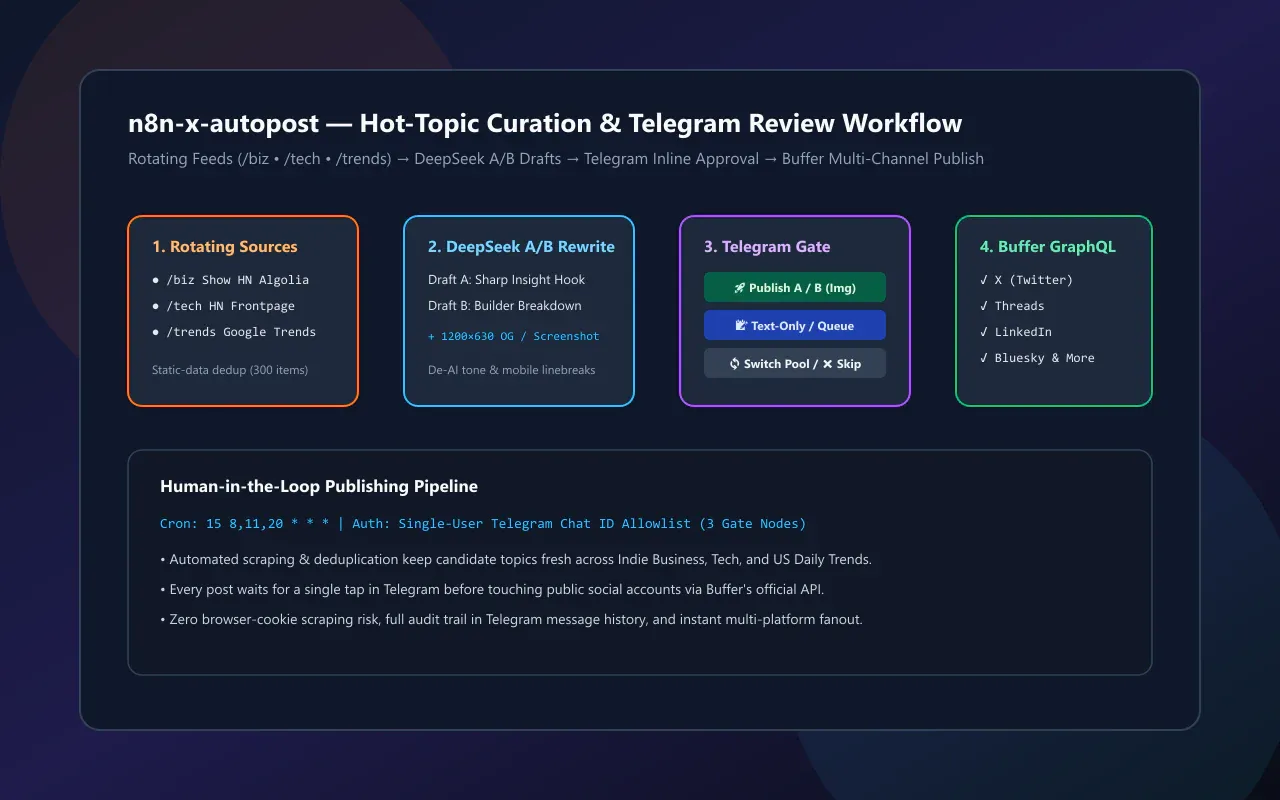
n8n-x-autopost takes a human-in-the-loop (80% automated preparation + 20% human editorial judgment) approach. An n8n workflow rotates across three high-signal topic pools, deduplicates against a 300-item sliding window, generates two distinct A/B drafts with DeepSeek alongside a 1200×630 preview card, and delivers an interactive review message to Telegram. A single tap on an inline button publishes immediately—or schedules to a queue—across multiple social networks through Buffer’s official GraphQL API.
Why Human-in-the-Loop Instead of Unattended Auto-Posting? Automating feed curation, deduplication, A/B drafting, and image rendering removes over 80% of daily friction, while keeping a 5-second Telegram approval gate ensures every published post reflects a deliberate editorial choice.
Core workflow capabilities
1. Three rotating topic pools & deduplication
Triggered on a cron schedule (08:15, 11:15, 20:15 daily) or on demand via Telegram commands (/biz, /tech, /trends), rotating across Indie Business (Show HN via Algolia), Tech (HN front page), and US Daily Trends (Google Trends RSS) with a 300-item static-data deduplication window.
2. DeepSeek A/B drafting & automatic visuals
Generates two contrasting narrative angles (Draft A and Draft B) per story with mobile-friendly short-line spacing and anti-cliché prompt constraints, paired with a 1200×630 preview image (GitHub OpenGraph social card or 11ty page screenshot).
3. Single-user Telegram gate & inline controls
Enforces a strict YOUR_TELEGRAM_CHAT_ID allowlist across all three entry points. Each review card includes inline buttons to publish A or B with an image, publish text-only, add to the Buffer queue, switch topic pools, or skip.
4. Multi-platform fanout via Buffer GraphQL
Uses Buffer’s official GraphQL API (createPost mutation by channelId) instead of brittle headless browsers, supporting X, Threads, LinkedIn, Bluesky, Mastodon, and parallel multi-channel publishing.
End-to-end pipeline architecture
The entire pipeline ships as a single self-contained n8n workflow JSON organized into four stages:
| Pipeline stage | Automated responsibility | Key engineering constraint |
|---|---|---|
| 1. Rotating feeds & dedup | Polls Show HN, HN front page, and Google Trends RSS |
Sliding 300-item static-data history prevents duplicate pitches |
| 2. DeepSeek A/B rewrite & image | Produces Draft A (insight hook) + Draft B (builder breakdown) + 1200×630 image | Prompt rules enforce short lines and strip generic AI filler |
| 3. Telegram inline review gate | Delivers preview card with publish, text-only, queue, pool-switch, and skip buttons | Enforces YOUR_TELEGRAM_CHAT_ID allowlist across all 3 trigger nodes |
| 4. Buffer GraphQL fanout | Calls Buffer createPost and edits the Telegram message in place |
Turns Telegram chat history into an auditable publishing log |
Four-step editorial loop
- Scheduled push or on-demand pull (
/biz,/tech,/trends): In addition to three daily scheduled runs, sending/biz(Show HN indie products),/tech(top Hacker News discussions), or/trends(Google Trends US daily stories) in Telegram immediately fetches the next unseen candidate from that pool. - Context extraction, A/B rewriting & preview card: n8n extracts the source title, URL, and discussion context, prompts DeepSeek to write two contrasting drafts (Draft A and Draft B), attaches a 1200×630 social card or webpage screenshot, and sends the package to Telegram.
- One-tap decision in Telegram: Review both drafts on mobile and tap an inline button:
🚀 Publish A/B(with image),📝 Text-Only A/B,📅 Queue A/B(push to Buffer’s scheduled queue),🔄 Biz/Tech/Trends(switch topic pool immediately), or❌ Skip. - In-place message audit trail & multi-channel delivery: Once a button is tapped, n8n executes the Buffer
createPostmutation and edits the original Telegram message in place with the final status (✅ Published,📅 Queued, or❌ Skipped).
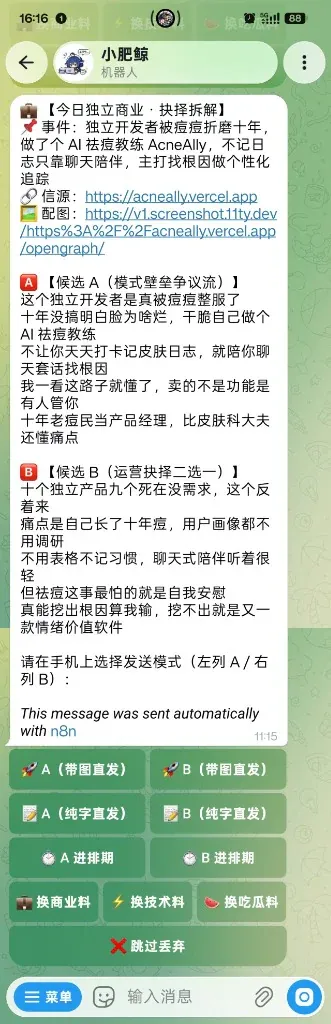
Live Telegram review card displaying the source link, Draft A and Draft B copy, and the inline button matrix for instant publishing, queuing, or switching topic pools.
Sanitized, ready-to-import blueprint
To make the workflow easy to adopt on any self-hosted or cloud n8n instance:
- Zero hardcoded secrets: All Telegram chat IDs, Buffer channel IDs, and API credentials are parameterized with clean placeholders alongside bilingual step-by-step setup documentation.
- Composable multi-channel fanout: Because Buffer’s GraphQL endpoint routes posts by
channelId, duplicating the publish node lets a single Telegram approval fan out to X, Threads, LinkedIn, and Bluesky simultaneously.
For the importable workflow.json, Buffer channel discovery queries, and setup instructions, visit the n8n-x-autopost GitHub repository.